
The Semantic Treadmill: How words lose their power

Have you ever noticed how certain words just don't pack the same punch they used to? Like how "awesome" went from describing the overwhelming majesty of the Grand Canyon to being what we say when someone brings donuts to the office?
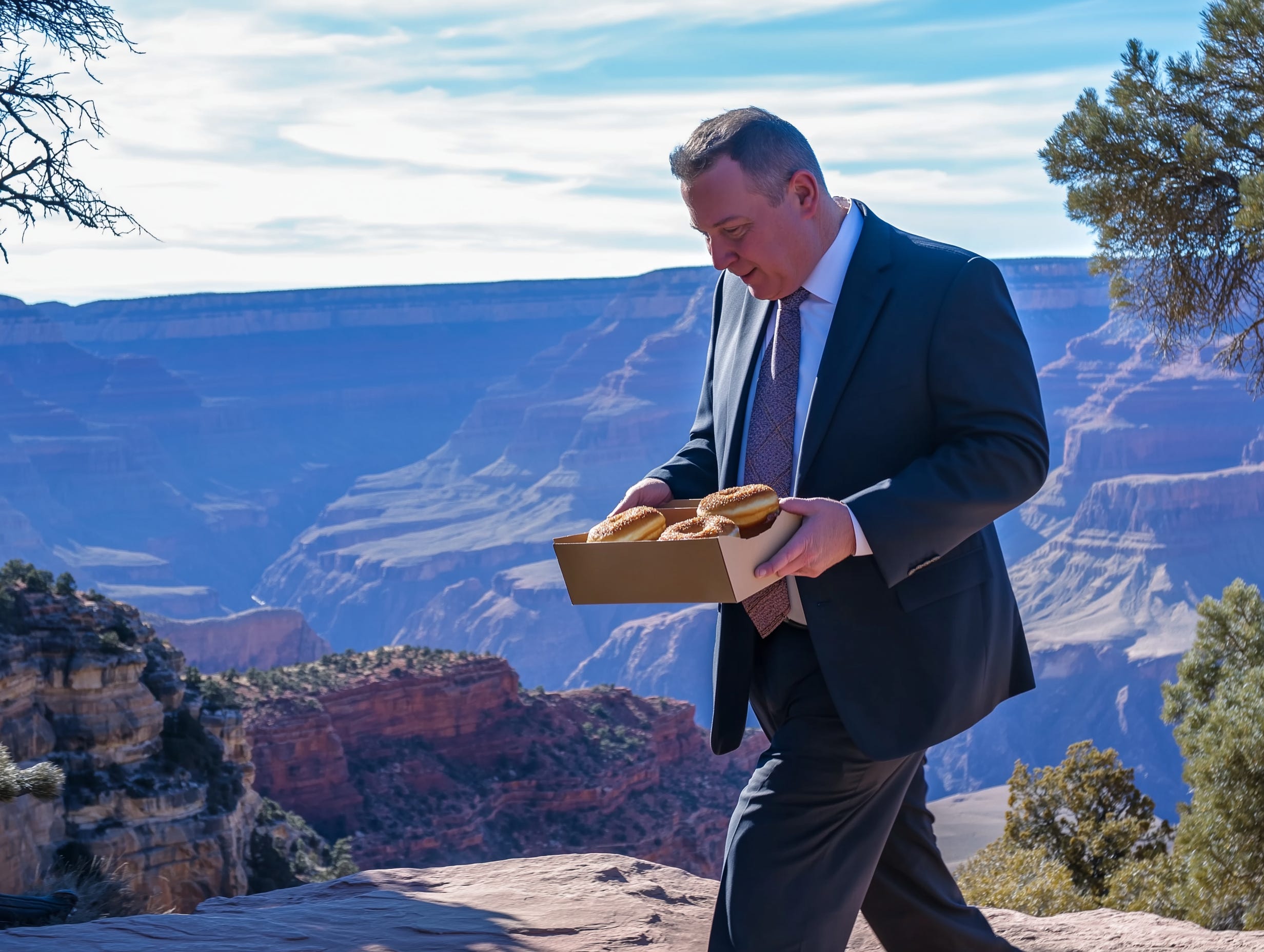
Like runners on a treadmill, our words need to keep changing for our meaning to stay still. I call it the “semantic treadmill”, inspired by the concept of the "hedonic treadmill" in psychology, which I'll get to later in this post. And like many aspects of language, the changing meaning of words often becomes hotly contested territory in our culture wars – just think of debates over terms like "racist" or "socialist."
This linguistic evolution shows up in two main patterns: "thingification" (where specific terms become increasingly general) and "emphasis inflation" (where, just like monetary inflation requires more dollars to buy the same goods, we need ever-stronger expressions to convey the same emotional impact).
When Specific Things Become... Well, Things
The word "thing" itself tells the perfect story here. About 3,000 years ago, if you were hanging out with your Proto-Germanic friends and they mentioned a "þingą" (pronounced roughly “thinga”) they were talking about a formal assembly where important matters were discussed. Kind of like a town hall meeting, but probably with more axes and mead.
Over time, "þingą" started referring to the matters discussed at these assemblies. Then it broadened to mean any matter or issue. Fast forward to today, and “thing” is our placeholder word for literally anything we can't be bothered to name specifically. "Can you hand me that thing over there?". “Things are looking up!”. “Wait, is ‘emotional support water bottle’ a thing now?”.
We've basically turned an ancient word for "important formal gathering" into the verbal equivalent of pointing and grunting.
This pattern keeps repeating across languages and cultures:
The Polish 'rzecz' and Ukrainian 'річ' (meaning "thing") come from words that originally meant "speech."
Romanian 'chestie' is actually a cousin of the English word "question."
The Armenian 'բան', Hebrew 'דבר', Finnish 'juttu', and Vietnamese 'điều' all started as speech-related words before becoming generic terms for "things."
The French 'chose' and Albanian 'kafshë' trace back to the Latin 'causa' – meaning a legal case or reason.
In Irish English, ‘yoke’ has been thingified — perhaps having evolved from the specific farming tool to meaning any tool, to meaning any object at all.
In Australia, where I’m from, we have a turn of phrase ‘old mate’ that’s used not to mean an old friend, but as a placeholder for any person at all, e.g. “has old mate gotten back to you yet?”
My partner and I have evolved a bit of a language of our own, and in it, every meal is "lunch" and all forms of entertainment are "movies."
This phenomenon isn’t all that surprising when you think about it: Firstly, we need a placeholder word for things that we don’t have a word for yet. Secondly, we’re lazy and dumb, and thinking of the most specific word to describe what we mean is hard. So thingification is a fairly uncontroversial way our languages evolve, unlike the other one..
The Inflation of Emphasis
The second pattern works just like monetary inflation: over time, you need more and more to get the same value. Just as a dollar buys less than it used to, individual words gradually lose their impact through repeated use, forcing us to continually seek stronger expressions. It's like we're all competing in an arms race of emphasis, and last year's nuclear option is this year's peashooter.
Take "awesome." Originally, it described experiences that literally inspired awe – like witnessing the Northern Lights or having a religious epiphany. Now? It’s the kind of thing I’ll say when the final colleague has showed up to a dry work meeting.
Some words become less emphatic and more general (i.e. ‘thingified’) at the same time. For example, “great” used to be a strongly positive word that also specifically meant ‘large’. Now it just means good. “Weird” used to mean that something was ‘destined’, then ‘supernatural’, and now just a bit odd.
This inflation doesn't just affect casual expressions — it also creeps into more serious concepts. This is known as "concept creep": terms that originally described extreme phenomena gradually expand to cover milder cases. "Trauma" once meant only life-threatening experiences or severe psychological wounds. Now it encompasses a much wider range of negative experiences. "Racist" has expanded from describing someone with explicit beliefs in racial supremacy to being used to describe people’s unconscious xenophobic biases, or — if some corners of the internet are to be believed — not liking the movie ‘The Black Panther’.
Unsurprisingly, whether these semantic shifts are good or bad becomes yet another hill people are willing to die on in our culture wars. Critics argue that broadening these terms diminishes their impact, trivializes serious issues and desensitises us to these words as labels, leading to “boy who cried wolf” effects. Defenders counter that we're simply becoming more attuned to subtler but nonetheless real manifestations of these phenomena. Whilst the outcomes of these debates might influence how long it takes for certain words to lose their impact, the outcome seems more or less inevitable.
The Evolution of "No": Why Double Negatives Make Historical Sense
Ever wonder why some people say things like "I didn't see nothing" or "I ain't going nowhere"? While grammar sticklers might cringe, double negatives are perfectly grammatical in many languages. Our notion that they're "incorrect" in English is purely arbitrary — an accident of history. What's more interesting is that these double negatives reveal a perfect example of the semantic treadmill in action: languages constantly seeking stronger ways to say "no."
Linguists call it Jespersen's Cycle, and it's like watching our constant search for emphasis play out in slow motion.
Here's how it typically goes:
A language starts simple. Old French speakers would say "Je ne mange" (I don't eat).
But sometimes this isn't emphatic enough, so people add reinforcing phrases. French speakers began saying "Je ne mange pas" – literally "I don't eat a step." This is like saying "I didn't eat a bit" or "I didn't drink a drop" in English.
The reinforcing phrase becomes standard and loses its emphasis. In modern French, "pas" is just the normal way to say "not" – no one thinks about it as meaning ‘step’ anymore.
Then, sometimes, the original marker starts to fade away: In casual modern French, speakers often drop the "ne" entirely, saying simply "Je mange pas." They're literally saying "I eat step" without realizing it.
Then the cycle can begin again with new reinforcing phrases.
This is process is happening currently in several Arabic dialects, as well as parts of Italy where “I didn’t eat” is becoming “I didn’t eat a crumb” and more recently “I eat a crumb”. Confusing.
This same pattern has, in fact, played out in English": In Old English, you'd say "ic ne geseah" for "I didn't see." Speakers then added the word "nauȝt" (meaning "no thing") for emphasis – giving us Middle English "I ne ysauȝ nauȝt". This means that in Middle English it was totally grammatically correct to effectively say "I didn't see nothing"! This later evolved into Early Modern English's "I saw not."
Languages handle these multiple negatives in different ways. Some, like Russian, embrace "negative concord" where multiple negatives reinforce each other. Others, like modern standard English, decided (somewhat arbitrarily) that two negatives should cancel out to make a positive. What's fascinating is that English used to happily use negative concord, until some 18th-century grammarians decided it was illogical and now it has become stigmatized. Although, I must say, I find it hard to shake the biased feeling that the way we do things in Modern English is right!
Does any of this matter?
Maybe not — maybe it’s just trivia. (Although even if that’s true, I personally find it super interesting to step back and look at some of the weird ways we use language without realizing it — I mean.. the French are saying “I eat a step” to mean “I didn’t eat”! )
But I don’t think this constant dilution of linguistic impact isn't just a curious pattern. I think it might reflect something more fundamental about how our brains work. Psychologists talk about the "hedonic treadmill" — our tendency to return to a baseline level of happiness despite changes in our circumstances. Get that dream promotion? After the initial elation, you'll drift back to your baseline. Lose a limb? After the initial trauma, most people's happiness levels largely recover. Our brains are remarkably good at adapting to new circumstances, treating them as the new normal.

I see this adaptation as a kind of psychological homeostasis — a defense mechanism that stops us from being perpetually overwhelmed by an overwhelming world. But it comes with a cost: we need ever-stronger stimuli to get the same emotional impact. So we’re constantly yearning for more extreme experiences and more emphatic language.
So the next time you catch yourself describing something mundane as "absolutely incredible" or "literally mind-blowing," remember: you're not being hyperbolic — you're just trying to keep up with the semantic treadmill. And that's pretty awesome (by which I mean, it’s fine I guess).
I first came across the linguistics stuff in this blog in a video from the YouTube creator Nakari Speardane. Thanks to them for the inspiration!
Late to the party and just read this. It resonates with me as someone who often mourns the way our language feels like it is becoming less expressive as more words become synonyms rather than expressing shades. And the fact that people look at you weird if you use some of these more expressive, less-commong words (or meanings of common words.) "Awesome" is one I've thought about before too.
I kept expecting you to draw a connection to the way condemnations like nazi, etc. have been reduced to nothing in western political discourse!
I’m seeing the semantic treadmill everywhere after reading this. Particularly in messages where I have the reflex to use 400 emojis and 150 exclamation marks to show I’m being polite and or enthused!!!